

Digital transformation has entered a different stage. For years, the debate focused on technological adoption, operational efficiency and the ability of organizations to adapt to new channels, new tools and new models of customer relationships. That stage has not disappeared, but it no longer explains on its own the scale of the transformation we are experiencing.
Artificial intelligence, digital platforms and algorithmic systems are no longer external elements to social, economic and institutional life. Today, they are part of the infrastructure through which citizens, companies and public institutions access information, interact, make decisions and exercise rights. That is why talking about technology is no longer only about innovation. It is also about democracy, trust, responsibility and safeguards.
This was the underlying theme of the International Digital Rights Summit, held on May 13 and 14 at Barcelona’s Llotja de Mar. Organized by the Government of Spain and Mobile World Capital Barcelona within the framework of the Digital Rights Observatory, the event brought together institutional leaders, international experts, academics, legal scholars, technologists and representatives of civil society to address the major challenges shaping today’s digital environment.
At Bizital, we participated in this summit because we believe that those of us working in digital transformation cannot remain outside this conversation. Implementing technology without understanding its social, ethical and democratic implications is no longer a responsible option. The digitalization of the future will require judgment, rigor and a clear vision of the role digital rights must play in the economy we are building.
Digital rights are no longer an extension of the technology debate; they are a condition of citizenship
One of the most important messages of the summit was that rights cannot weaken when life moves into digital environments. If an increasing part of our social, economic and political activity takes place on platforms, automated systems and data-driven environments, then the protection of citizens must evolve alongside that shift.
Privacy, digital identity, child protection, freedom of expression, security, algorithmic transparency and protection against disinformation are not isolated technical issues. They are all part of the same democratic architecture. The summit program itself was structured around challenges such as child protection, freedom of expression and disinformation, cybersecurity, technological sovereignty, identity, privacy and the ethical and labor implications of artificial intelligence.
This is an especially important issue for the business community. Companies no longer simply operate “on the internet”; they operate within a regulated, sensitive and increasingly demanding environment where digital trust becomes part of the value proposition. The way an organization collects data, automates processes, uses artificial intelligence or communicates with customers will have a direct impact on its reputation, regulatory compliance and legitimacy in the market.
At Bizital, we defend one clear idea: digital transformation will only be sustainable if it incorporates a serious understanding of digital rights from the very beginning. Not as a legal add-on, not as a secondary obligation, but as a principle of business design.
Artificial intelligence raises a democratic question before a technological one
The question that ran throughout the summit was direct: what happens when systems capable of influencing information, public opinion, productivity, labor and decision-making are deployed faster than society’s and institutions’ ability to fully understand them?
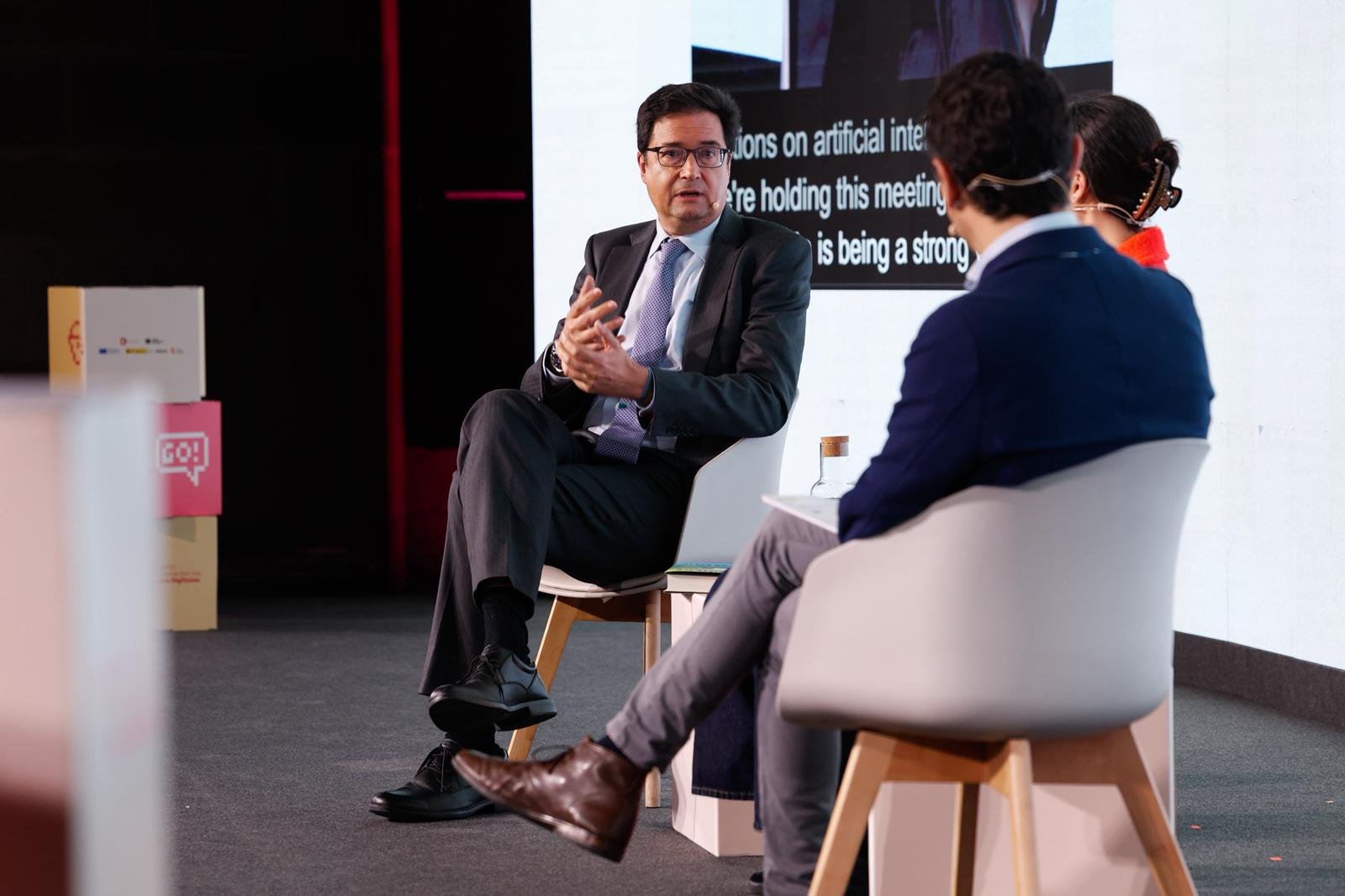
Spain’s Minister for Digital Transformation and Public Administration, Óscar López, framed the debate in particularly relevant terms by comparing the current moment of artificial intelligence and social media with the financial deregulation that preceded the 2008 crisis. His remarks pointed to a deeper idea: when extremely complex technologies or systems operate without sufficient transparency, oversight and accountability, the risk is not only technical; it is structural.
This comparison matters because it shifts the debate. The question is not whether artificial intelligence should advance or not. The question is under what conditions it should advance. Innovation requires frameworks capable of generating trust, especially when it affects fundamental rights, democratic processes and large-scale economic relationships.
At this point, Europe is trying to build its own position. It is not only about competing in speed with the United States or China, but about defending a model in which technological capability is accompanied by democratic safeguards, digital sovereignty and institutional responsibility. This “third technological path” based on trustworthy artificial intelligence was one of the central ideas discussed during the summit.
For Bizital, this perspective is essential. Artificial intelligence cannot be understood only as a productivity tool. It is also a technology of influence. And when technology influences decisions, information, commercial relationships and internal processes, the responsibility of those implementing it increases.
The protection of citizens will become inseparable from business competitiveness
One of the most common mistakes in the digital debate is presenting the protection of rights and business competitiveness as opposing forces. That vision belongs to an earlier stage of the market. In the new landscape, trust will become a competitive advantage.
A company that better protects customer data, communicates transparently, automates responsibly and incorporates technology without compromising security or privacy is not slowing its growth. It is building a stronger foundation to sustain it.
The intervention of Jesús Herrero, Director General of Red.es, was especially relevant in this regard. Red.es stated that the summit was created with the goal of raising public awareness around a fundamental idea: our rights are also digital, and society must take part in the debate about the ethical use of technology.
That idea directly connects with the role of businesses. The protection of citizens does not depend only on institutions. It also depends on how organizations design their digital processes, which tools they adopt, how they manage information and the level of responsibility they assume when implementing automation or artificial intelligence.
Responsible digitalization is not a slogan. It is a way of operating. And it will become increasingly important in sectors where customer relationships, data management, online visibility, digital advertising and automation are part of the core business.
Digital democracy is also built through the everyday decisions of businesses
At first glance, talking about digital democracy may seem like a matter reserved for governments, regulators or major technology platforms. But that interpretation is incomplete. Digital democracy is also built through the everyday decisions of thousands of companies that design websites, manage campaigns, automate communications, collect data, implement tools and define how they interact with people in online environments.
Every digital decision carries a vision of trust. A clear privacy policy, a responsible data strategy, transparent automation or honest communication are not minor details. They are part of a business culture that understands technology must serve people, not stand above them.
At Bizital, we believe digital transformation should help companies grow, but also help them do so responsibly. This position does not stem from an abstract concern, but from a concrete reality: SMEs and self-employed professionals are also part of the new digital ecosystem and need to adopt technology without losing control, security or trust.
The debate around digital rights cannot remain confined to large institutions. It must reach the real business fabric. That is where a decisive part of Spain’s digital future will be shaped.
Barcelona as a space where the new digital pact is being defined
The choice of Barcelona as the host city for the International Digital Rights Summit was no coincidence. For years, the city has held a relevant position within the European technology ecosystem, especially through its relationship with Mobile World Capital Barcelona and the Mobile World Congress. But this summit adds a different dimension: it is not only about talking about innovation, but about debating the rules, responsibilities and safeguards of the new digital environment.

Barcelona is therefore consolidating itself as a place where technology, institutions, civil society and businesses can come together to address a question that will define the next decade: how to build a competitive digital model without renouncing fundamental rights.
At Bizital, being part of these conversations is consistent with the way we understand the sector. Digital transformation is not only about implementing solutions. It is about understanding the context in which those solutions will operate, anticipating the changes ahead and helping companies make better informed decisions.
Bizital’s position: digitalizing with judgment, responsibility and long-term vision
The International Digital Rights Summit confirms a reality that we at Bizital have been observing for some time: the next stage of digital transformation will not be defined only by the adoption of technology, but by the ability to integrate it responsibly.
The companies that lead the coming years will not simply be those using more digital tools or incorporating more artificial intelligence. They will be the ones that best understand the environment in which they operate, better protect the trust of their customers and acknowledge that technology carries economic, social and democratic consequences.
Our role in this new landscape is clear. We want to help companies grow within the digital environment, but also to do so with a mature vision of technology. A vision where efficiency does not replace responsibility, where automation does not eliminate transparency and where innovation is not built at the expense of people’s rights.
Because the digital future will not only be more technological. It will also need to be more trustworthy, more secure and more conscious of its impact.
And those of us participating in its construction have the responsibility to rise to that challenge.